Luke 2: A Shepherd’s Christmas Story on the Margins (Reflection 3)

Luke 2:9-10 An angel of the Lord appeared to them, and the glory of the Lord shone around them, and they were absolutely terrified. But the angel said to them, “Do not be afraid! Listen carefully, for I proclaim to you good news that brings great joy to all the people:

I can’t imagine what was going through the shepherd’s minds as these angels appeared before them. We do know that they are terrified, and I am sure they could not fathom any good reason why they would have such an encounter. They were just some everyday, round the way, shepherds’, trying to feed their families, trying to survive Roman oppression, and trying to keep their dignity in the midst of death-dealing marginalization. And yet it was to them whom the angels are sent, and it was these shepherds that were entrusted with the most important life-giving messages. This message of good news goes first to the marginalized. It was a life changing announcement that would change everything. This was a message that brings hope to the poor, uplifts the broken hearted, revitalizes the tired, liberates the oppressed, and declares that the Jubilee of God’s Kingdom has broken into our world.

Verse 11 Today your Savior is born in the city of David. He is Christ the Lord.

And here is what that good news that they shared was. It was that on that day, a savior, a deliverer, a liberator was to born in the city of David. He is the Messiah, the awaited King of Israel who was prophesied about in the Jewish scriptures. This Messiah, this Christ is the true Lord.  For us then that means that all those counterfeit lords that demand our full allegiance will be exposed as the frauds and fakes that they are in the moment of complete revelation and ultimate consummation. For Jesus is the fullness of the Deity in bodily form. He is the same Yahweh who made covenant and relationship with the Israelites. He is the same God who spoke all creation into existence. And it is in and through Him that all things are held together. He is Jesus the Christ.

Verse 12 This will be a sign for you: You will find a baby wrapped in strips of cloth and lying in a manger.”

Can you imagine how elated these shepherds must have been at this moment? Angels had just revealed to them the greatest news in all of human history, a message that will bring great joy to the world, because the liberator and king, the prophesied Christ on that day is to be born. But notice the sign that the angels give, which will identify Jesus to the shepherds as the Messiah. They told them that they would find Jesus, the King of Kings and Lord of Lords… laying in a feeding trough. That is the way that they will identify Jesus. He won’t be identified because of some royal procession, he won’t be identified for being born in a palace, and he won’t be identified because of a royal announcement that was given. No instead, he would be recognized for being born in some little town out in the country, laying in a humble feeding trough. The very location and circumstance of his birth was a symbol and sign of solidarity with the socially outcast. It bears witness to the fact that “God chose what is low and despised in the world, what is regarded as nothing, to set aside what is regarded as something.” And so we must consider the significance of why the Most High God would choose to express himself in such lowly way. Howard Thurman, in his classic book Jesus and the Disinherited, noted three things that are often ignored about Jesus’ birth and life. 1st was that Jesus was Jewish culturally, religiously, and ethnically. 2nd Jesus was poor. And 3rd, Jesus lived a subdominant and oppressed life under the rule of the Roman Empire. These are more than merely interesting facts about Jesus, given that these are the precise ways that God chose to reveal himself to the world, it demonstrates God’s solidarity with the majority of the world who struggle in poverty and oppression. And it is in the place of marginalization that God has chosen to be victorious over sin and death, and over rulers and authorities. Jesus birth in the manger is a protest against the powers of this world that denigrate the dispossessed. In his incarnation, Jesus dismisses the narrative of the powerful and insists that the good news is for all. That is all who are willing to abandon self and embrace Jesus and His Kingdom.

Luke 2: A Shepherd’s Christmas Story on the Margins (Reflection 2)

What is interesting about discussing people who are marginalized, is that we never seem to like to talk about their subsequent counterparts. For example, it is very common to talk about those who are underprivileged. In our minds we have arrived at an arbitrary determination on what the standard of privilege is, and we recognize that some people happen to be under that level of privilege. Yet we never go further and ask how entire communities or even countries become “underprivileged”. As if North Philly just became poor on its own. As if Haiti’s poverty has nothing to do with France’s occupation, slavery, and exploitation of that nation. Take it a bit further and we must consider that if there is such a thing as “underprivileged”, then why don’t we ever talk about those who are “over-privileged”. For there to be an underprivileged means that there must be its grammatical opposite. But when we talk about people being “over-privileged” it gets us all uncomfortable. You see marginalized people are marginalized because others have claimed the center, something that only God has rights to. If people did not selfishly and sinfully prioritize themselves over others, people would not be marginalized. Marginalization requires that some are participating in the practice of centralization, that is the dominating and excluding of others for one’s own gain. The shepherd’s here are left on the fringes of society and under an empire that has a centralized mentality, which is opposite to the other-oriented love that we are called to share with the world as followers of Christ.

Let’s jump back to the beginning of the chapter…

Verse 1: Now in those days a decree went out from Caesar Augustus to register all the empire for taxes. (NET)

We are in the midst of exploring God’s special favor as he entrusts the good news with these mere marginalized shepherds. At the same exact point, we see in verse 1 of chapter 2, that Caesar Augustus, the Roman Emperor, is making a decree that has the whole empire registering for taxes. What is ironic here is that Augustus has conquered and consolidated the Roman Empire, where he took captive control with a centralized power over the entire empire. Furthermore, he claimed that his adopted father, Julius Caesar was divine after he passed away, and even audaciously began to refer to himself as “a son of god”, believing his own press, which claimed that he had brought peace and justice to the world after controlling the Roman Empire. This was a claim that only God was rightfully due. And yet, with all his centralized power, the Emperor is clueless of what is taking place in the little town of Bethlehem. God was in the midst of enacting the greatest moment in human history, the birth of Jesus, which in a few decades would become an unstoppable subversive force that not even the most powerful empire in the world could halt. Even here at this moment in the story, Caesar is so distant from God’s presence, activity, and movement in the world. He is so removed from God’s Main Stage that he is clueless of Jesus’ birth. Despite his registering all people in his empire, he doesn’t even have Jesus on his radar. He will never even see Jesus face to face. In essence, the one who has attempted to occupy the center is actually the most marginalized one in God’s redemptive activity in the world, excluded from experiencing this most amazing moment in human history.

Luke 2 A Shepherd’s Christmas Story on The Margins (Reflection 1)

It’s Christmas eve, and we have approached the celebration of Christmas. Let’s reflect on a passage today that will hopefully open our eyes to God’s subversive and revolutionary act of incarnating into our world on the margins. And so we will jump into Luke’s account of the Shepherds receiving the announcement of Jesus’ birth. Let us consider the implications of what God was doing in this and why it matters for us not only during this Christmas season, but every day as we faithfully follow our Suffering and Crucified Servant in the Margins, in hopes that we might be exalted with our Majestic and Victorious Messiah on His Main Stage.

8 Now there were shepherds nearby living out in the field, keeping guard over their flock at night.

Now, before we move any further, we need to park here for a second. We need to understand what it meant to be a shepherd in 1st century Palestine. You see the shepherd’s lived a life of marginalization. During this time, Rome was the ruling empire of the land, and so all of Israel understood what it meant to be oppressed and what it meant to live life with someone’s foot against your neck. The Jews despised their Roman occupiers and desperately wanted to see them kicked out of their land. They were oppressed, exploited, and humiliated. And yet, when we understand the social class of shepherd’s in this context, we remember that they themselves among their own people were despised and unwanted, seen as misfits and cheats, and left living on the margins of society.

There are lots of people who understand what it is like to be marginalized, what it is like to be unwanted, what it is like to be stereotyped and lied on. What a horrible thing it is when we lie on others claiming that they are something other than people made in God’s image and to whom God loves immensely. What a horrible thing it is when we exclude people from participating in the life of communities and societies, ignored and invisible to the masses. What a horrible thing it is when you are marginalized, and left on the fringes, only to encounter others who hold a spirit of apathy and contempt against you’re very existence. This was the life of a 1st century shepherd living in Galilee.

Thanksgiving? (Repost)

Thanksgiving has always been one of my favorite holidays… it is centered most around family and food, two things I love dearly.  In addition, because of my family”s Christian heritage, we saw it fit to share what we were thankful for… attempting to embody this thing called gratefulness.  But is that really the right posture we ought to have as Christians towards Thanksgiving day?

The central issues that ought be considered have to do with history, memory, narrative, and power. As they say… the winner gets to right the history books.  In this case, it is a warm fuzzy story of indigenous Americans helping the Europeans through a rough start, and them sharing a meal. The picture in my mind just leaves me feeling warm and fuzzy all over.  However, what is not mentioned is that while the natives did in fact show much hospitality, the Western Europeans came and took everything from them.   It is a story of conquest, imperialism, colonization, disease, suffering, loss, and almost complete genocide.

I do not dare suggest that a heart of gratitude is always an appropriate attitude to have at all times.  We ought to be people that give thanks.  But we should also be discerning people who give thanks for appropriate things.  In this case, this “holiday” is a power move by the strong, to narrate history in a way that favors what was done.  I am sure that this holiday is seen as hurtful and insulting to many 1st nations peoples.

This would be like their being a holiday to celebrate how helpful the African indentured servants were in 1619 in Jamestown, and how appreciative the westerners were of their hardwork.  So because of this beautiful collaboration we are going to celebrate Unity Day through large festivities and parties.  If this did exist, I am pretty sure what position I would take in response.  So why is thanksgiving any different?  Well as I write I am heading off to church and then family to “celebrate”.  It must be our apathy towards others that allow us to ignore the sufferings of others.

….Never Forget….

Certainty or Confidence?

Image from science.howstuffworks.com

I was at Biblical Seminary yesterday, and ended up entering an interesting conversation with a Reformed student and an Anabaptist student there. Overall, we discussed some of the differences in the two movements, and why both are currently attracting people from various traditions. While we found a lot we could agree on (as individuals) we also agreed that in many ways the Neo-reformed and Neo-anabaptist movements were in many ways opposites of each other.

In the midst of this conversation, began to talk about faith. My reformed friend really wanted to use the “certainty”, while my anabaptist sister and I both leaned away from that term, and preferred terms like, faith, hope, belief, assurance, conviction, and finally confidence.

It may seem like semantics, but something is definitely distinct about those different options. I grew up in (and still currently attend) a church where they stressed that “you gotta know, that you know, that you know”. Sounds good right? But can we as finite human beings know anything with objective precision, as we sometimes like to claim, or is that unique ability only capable for the Obective One. As I have grown older, I have tended to agree with scripture that teaches that his ways are way above are ways, and that we can not even begin to fathom God fully, or exactly what he has and is up to (fully). Don’t get me wrong, I believe that God has revealed himself to us, particularly in his son Jesus. But I understand that my faith and hope I have is one that has been mustered up in a finite body. Furthermore, the scientific method can offer no means of assurance in matters of faith and God, which compels me to release words like “certainty” out of my theological linguistic categories, because it wreaks of scientific vernacular. I wouldn’t say that its usage is completely out of place, but rather it is unhelpful in many of our heavily modernity leaning church contexts.

Speaking only for myself, my faith in Jesus is not a result of certainty but of my genuine belief, conviction, hope, and confidence that I have placed in his birth, life, teachings, death, physical resurrection, and in his ultimate return. Does this distinction even matter?

Dr. Jeremiah Wright

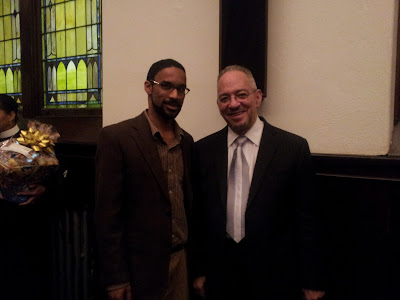
Dr. Jeremiah Wright and Drew Hart

So Jeremiah Wright was in Philly, on my block. He spoke on the 14th and the 15th at the traditional baptist church on the corner.  Unfortunately, I was sick and was only able to make it out on the 15th. He looked at how Paul and Silas were treated, along with how they responded to that treatment, and its final outcome. He compared their being put “in an awkward predicament” having done nothing wrong, and having been lied on, with the African American experience of slavery, suffering, and stereotypes (my alliteration, not his).

He called on folks to respond with prayer, realizing that our prayers are being heard by God in ways we cannot fathom. He also called on us to praise, in which he particularly highlighted the need to pass on the negro spirituals and old songs that have sustained our community for generations.

He also reminded us that God likes to work in the midnight hour, over and over again, he shows up in the midnight hour, turning the situation around. He said much more, unfortunately I didn’t take notes, and so this is the core of what I remember of the top of my head, two days later.

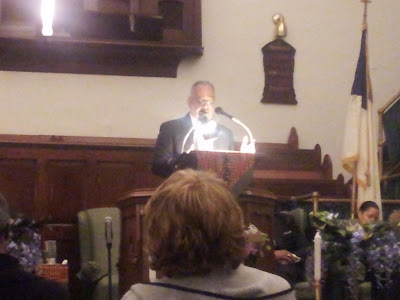
Jeremiah Wright in the Pulpit

Finally, I just want to state that Jeremiah Wright is a lyricist. Yes, he is a wordsmith, who carefully crafts and delivers words with power, courage, creativity, and prophetic imagination. I thoroughly enjoyed just hearing him speak, nonetheless actually receiving the content packaged in his brilliance.

I know that Jeremiah Wright is a controversial figure to many in our country, but I urge you to move past the sound bites, and you will see that he is nothing more than a continuation of the black prophetic tradition that we see in the likes of Sojourner Truth, Frederick Douglas, Ida B. Wells, Fred Shuttlesworth, Martin Luther King, Jr., and other courageous black christian leaders who spoke truth to power, whether or not it was convenient or popular. In the case of speaking against racism on a systemic level in America, it has never been popular with the dominant culture.

11/11/11

In the 11th book of the Bible (1 Kings), in the 11th chapter, at verse 11, you find the following verse.

“So the Lord said to Solomon, “Because you insist on doing these things and have not kept the covenantal rules I gave you,t I will surely tear the kingdom away from you and give it to your servant.” (NET)

Solomon has hoarded wealth and has turned away from faithfully following God, instead worshiping the idols of his foreign wives. Here at 11/11/11 in the Bible we find God explicitly stating that this break in covenant will result in the losing the inheritance and legacy of the kingdom and throne.

Throughout the Bible two reoccurring themes that jump out and off the page is God’s impatience for those who participate in idolatry and injustice. Want to see God angry… according to the tradition of scripture, all you need to do is participate in idolatry and/or injustice and it will come to fruition.

11/11/11 only comes around every 100 years. It could be a great time to evaluate our relationship with God and our concern for the marginalized. For in this reminder, we may save ourselves from exclusion from Christ’s Kingdom and Table.

Wright Around The Way!

Jeremiah Wright speaking at the church across the street.

Looking forward to Jeremiah Wright coming to my block next week, when he will be speaking at the Baptist church on my block on Monday and Tuesday. I have really appreciated his perspective. I honestly was not very familiar with him before President Obama and him split ways. From that point forward, specifically after hearing his response, I decisively was on #TeamWright. I am not an Obama hater, however, I did and continue to support the prophetic voice over and above a political positioning. President Obama at the end of the day is a politician, a politician for an empire. At the same point, Wright speaks out of conviction from subversive sub-dominant society, and more importantly on behalf of the Kingdom of God. We should never confuse politics from the center with prophetic subversion from the margins.

I’ll let you know how it goes. Likewise it gives me an excuse to hang out with my baptist brothers and sisters, it’s been so long 😉

Empire of Sacrifice

Today I finished a book by Jon Paul, called Empire of Sacrifice. He is a professor at Lutheran Seminary here in Philly, and one of the people I plan on connecting with to see if our academic interests line up enough for me to work with them in doctoral work. The book is primarily more in the field of Religion, and I am a bit more in the field of Theology, but there seem to be a lot of similar interests nonetheless in our intellectual thought process that it could possibly be a good fit.

Empire of Fear

In America, citizens are overwhelmed, burdened, and often defeated by fear. Doom and despair are the working hermeneutics for participants in Imperial America. This becomes especially apparent in American two party politics. To gain support for any political agenda, both sides use the threat of doom to scare people into supporting their policies. This method is surprisingly effective again and again.

God help us to reject the Empire of Fear and accept the Kingdom of Hope!